

Revolutionizing Triage with the Compensatory Reserve Index (CRI)
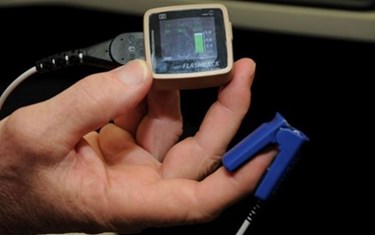
The core challenge in trauma care is identifying the silent phase of hemorrhage. Patients can lose a significant portion of their blood volume while appearing stable because the body compensates by increasing heart rate and constricting blood vessels. The CipherOx CRI-M1 was specifically designed to see through this mask and provide clinicians with actionable data when seconds matter most.
The Fuel Gauge for Human PhysiologyThe CRI-M1 operates on a scale from 1 to 0, providing a simple visual indicator of cardiovascular stability:
- Green (1.0 to 0.6): Represents a full compensatory reserve; the patient is considered stable or normovolemic.
- Yellow (0.6 to 0.3): Indicates a reduced reserve; the patient is actively losing central blood volume and requires immediate clinical attention.
- Red (0.3 to 0.0): Signals impending collapse; the body’s reserve is nearly exhausted, and total hemodynamic decompensation is imminent.
Clinical Evidence and Superiority over Traditional VitalsIn clinical evaluations, the Compensatory Reserve Index has consistently outperformed standard vital signs for identifying bleeding trauma patients.
- Higher Sensitivity: For predicting the need for life-saving interventions, CRI demonstrated a sensitivity of 83% compared to just 26% for systolic blood pressure.
- Earlier Detection: The CRI algorithm identifies significant hemorrhage requiring therapy more reliably than systolic blood pressure, identifying patients at risk of collapse much earlier than volunteers who are more tolerant of blood loss.
- Real-Time Resuscitation Monitoring: The 20-minute trend line allows practitioners to determine if their patient is continuing to bleed or if fluid resuscitation measures are effectively refilling the patient's fuel tank.
Non-Invasive Intelligence for Austere EnvironmentsDeveloped in collaboration with researchers studying both civilian and battlefield trauma, the CRI-M1 algorithm is optimized for high-stress environments. The device evaluates the shape of each blood waveform at the fingertip using an SpO2 sensor and requires minimal data to begin providing an accurate assessment.
- No Calibration Required: The system provides an actual CRI trend value that does not require relative calibration or initial baseline readings.
- Continuous Monitoring: Beat-to-beat analysis provides a continuous window into intravascular volume changes.
- Individualized Accuracy: Unlike standard age-adjusted tools, CRI is an individual-specific measure of compensation that provides real-time insight into central volume loss.
Impact on Healthcare StakeholdersBy reducing the noise and inconsistency in hemodynamic monitoring, Flashback Technologies empowers data-driven innovation across the clinical spectrum. Our platform provides healthcare leaders with a bridge between legacy data and modern, machine-learning-driven care, ensuring that critical medical intelligence is always actionable and accurate.

Lead the Future of Hemodynamic Safety
Be at the forefront of clinical innovation. Partner with us to implement the first-ever FDA-cleared "adjunctive cardiovascular status indicator" and eliminate the diagnostic lag in hemorrhage detection.