

FDA 510(k) Cleared

Detect Hemorrhage Before Vital Signs Change

The CipherOx CRI-M1 uses the Compensatory Reserve Index to identify internal bleeding up to 30 minutes before traditional vital signs deteriorate — giving clinicians a critical intervention window.

+32
Minutes Earlier
94%
Sensitivity
47%
Fewer Transfusions
Heart Rate
72 bpm
Blood Pressure
118/76
0.82
CRI Value
● Full Reserve
THE COMPENSATORY RESERVE INDEX

Traditional vital signs like heart rate and blood pressure remain stable until 30-40% of blood volume is lost. CRI detects physiological compensation in real-time, revealing hemorrhage while intervention is still possible.

icon
FDA 510(k) Cleared
icon
Non-Invasive Monitoring
icon
Real-Time CRI Trending
icon
Clinically Validated
bg element
Inside the Algorithm | Flashback Technologies
Technology Deep Dive

Inside the Algorithm

Explore how CipherSensor transforms raw arterial pulse data into the Compensatory Reserve Index — a lifesaving vital sign invisible to traditional monitors.

Drag to rotate · Click hotspots to explore
1
Signal Capture
2
Waveform Analysis
3
Feature Extraction
4
ML Engine
5
CRI Output

From Pulse to Prediction

Five stages transform raw photoplethysmographic data into the Compensatory Reserve Index — a continuous, patient-specific measure of hemodynamic stability.

01

Signal Acquisition

PPG waveform captured via pulse oximetry

02

Waveform Processing

Noise filtering and beat-to-beat normalization

03

Feature Extraction

750+ morphological features per cardiac cycle

04

ML Classification

CipherSensor pattern recognition engine

05

CRI Output

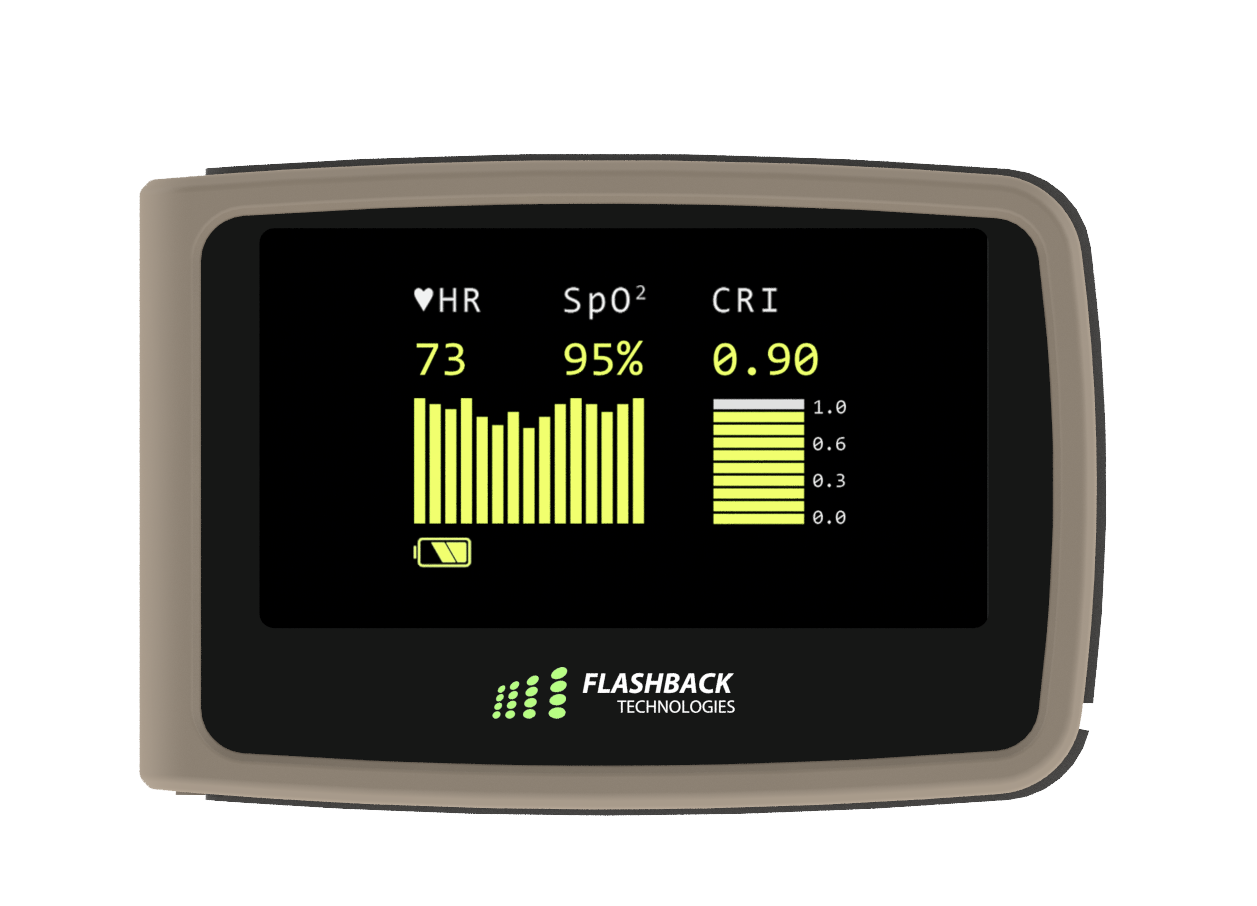
Continuous index from 1.0 to 0.0

bg element

Accelerate Discovery

We transform complex, fragmented medical data into actionable insights, allowing life-science teams to improve analytical accuracy and treatment evaluation.
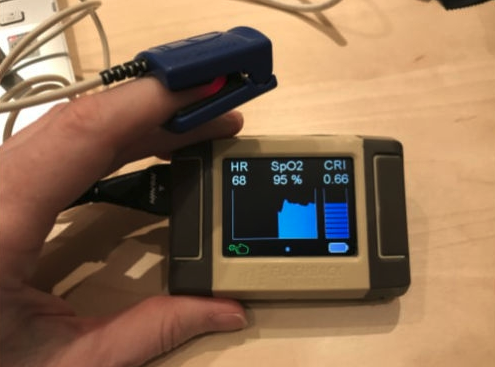
Precision Monitoring

With FDA-cleared technology like the CipherOx CRI-M1, we empower clinical teams to accurately detect and trend acute blood loss, improving reliability in critical care environments.

Bg Element
CLINICAL INTELLIGENCE

Scalable Data Processing

By combining machine learning and large-scale data processing, we create a powerful ecosystem for turning complex medical data into actionable intelligence.

Structured Medical Insights

Our platform transforms complex, fragmented medical data into structured, actionable insights to improve understanding and decision-making.

ML-Driven Data Normalization

We apply machine-learning models and data-normalization techniques to extract value from unstructured historical records and legacy datasets.


View Clinical Evidence
Dive Into Discovery
photo
photo
photo
CLINICAL TRUST

Actionable Intelligence, Trusted by Healthcare Leaders and Life-Science Teams

icon

Dr. Sarah M.

Lead Clinical Researcher

"The platform’s ability to normalize legacy datasets significantly accelerated our study. We finally have clarity on disease patterns that were previously hidden in noise."
icon

Michael L.

Health System Administrator

“Integrating their machine-learning models into our EHR workflow has optimized our decision-making. The accuracy in data interpretation is a game-changer for our operational efficiency.”
icon

James R.

MedTech Product Lead

“Flashback’s technology provided the analytical clarity we needed for our FDA-related evaluation. Their focus on reducing data inconsistency is exactly what the industry needs.”
How CRI Works

The Science Behind Early Detection

CRI analyzes photoplethysmography waveforms to measure your body's compensatory reserve — revealing blood loss before vital signs change.

1
PPG Signal Capture
Non-invasive sensor captures arterial waveform data from the patient's finger
2
Waveform Analysis
ML algorithm extracts 150+ features from each cardiac cycle waveform
3
Reserve Calculation
CRI score computed by comparing features to hemorrhage training data
4
Clinical Alert
Real-time CRI trending with alerts when reserve drops below threshold
Traditional Vital Signs
  • Remain stable during compensated shock
  • Change only after 30-40% blood loss
  • Limited intervention window
  • Reactive treatment approach
CRI Monitoring
  • Detects physiological compensation early
  • Alerts 30+ minutes before vitals change
  • Critical intervention window
  • Proactive treatment decisions
INSIGHTS & EVIDENCE

Advancing Medical Innovation Through Clearer Data Interpretation